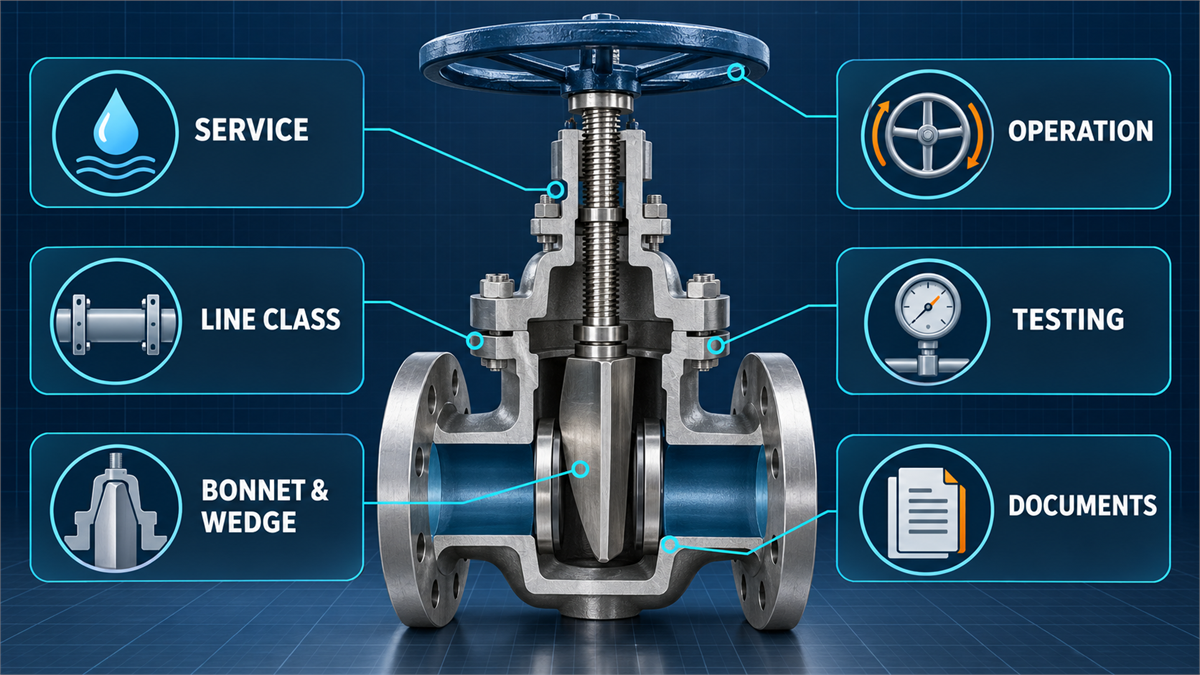
Short answer: a gate valve RFQ should define the service, governing documents, size and rating, end connections, body and bonnet route, wedge and seat construction, stem sealing, operation, inspection, documentation and commercial return. Sending only “gate valve, size, class and material” forces suppliers to make different assumptions. Use the same 30 fields for every bidder, require each assumption and deviation in writing, and compare the returned drawing, bill of materials and test scope before comparing price.
This checklist is a gate-valve-specific extension of the industrial valve inquiry checklist. It is designed for preliminary RFQs and technical bid tabulation; it does not replace the piping class, owner specification, controlled valve standard, process-safety review or approved datasheet.
Use Two Stages: Quotable First, Order-Ready Before Award
A buyer does not need every detail to ask for a preliminary quotation. Unknown items can be marked TBC, provided the supplier identifies the resulting assumptions. Before technical approval or purchase-order release, however, every configuration-critical and interface-critical field should be resolved or placed on an approved open-point register.
| Stage | Buyer responsibility | Supplier responsibility | Release condition |
|---|---|---|---|
| Preliminary inquiry | State known service, line-class, interface and delivery data; mark unknowns TBC | Propose a clearly identified route and list every assumption, option and exclusion | Enough common information exists to compare technical scope and budget |
| Technical bid review | Resolve conflicting requirements and issue clarifications to all bidders | Return completed datasheet, compliance matrix, drawing, BOM and document list | Bids are normalized to the same revision and supply boundary |
| Order-ready approval | Approve the selected configuration, deviations, ITP and document schedule | Incorporate comments and freeze the manufacturing baseline | No safety-, fit-, function- or evidence-critical assumption remains hidden |
Fields 1–7: Project and Service Basis
| # | RFQ field | Buyer input | Supplier return |
|---|---|---|---|
| 1 | Tag, line and quantity | Valve tag, line number, item quantity, installed spares and capital spares | Tag-wise quotation and traceable offer reference |
| 2 | Service fluid | Fluid name, composition, contaminants and concentration where relevant | Material-compatibility review assumptions and exclusions |
| 3 | Phase and solids | Liquid, gas, steam, two-phase behavior, particles, scale or crystallization risk | Any seat, cavity, drain or orientation limitation |
| 4 | Operating conditions | Normal and alternate operating pressure and temperature | Offered configuration suitability basis |
| 5 | Design cases | Design pressure/temperature, vacuum, reverse pressure, thermal and upset cases | Accepted cases and any case requiring a different option |
| 6 | Valve duty | Isolation duty, normally open/closed state, operating frequency and emergency use | Duty acceptance; do not assume throttling unless the offered design and project permit it |
| 7 | Site environment | Indoor/outdoor, ambient range, corrosion, flooding, fire zone and hazardous-area data | Coating, enclosure, accessory and preservation scope |
Media name alone is rarely enough. The same nominal service can have different corrosion, erosion, deposit, emissions or cleaning requirements. State the actual cases available to the project and ask the supplier to identify what remains unverified.
Fields 8–14: Standards, Rating and Piping Interfaces
| # | RFQ field | Buyer input | Supplier return |
|---|---|---|---|
| 8 | Document precedence | Purchase specification, line class, datasheet, valve standard and precedence rule | Compliance matrix against the exact listed revisions |
| 9 | Valve standard and edition | API, ASME, EN/DIN or other project route, including edition/addenda | Exact offered basis and all deviations; use the API valve types guide only as an orientation aid |
| 10 | Nominal size and rating | DN/NPS, PN/Class or other controlled rating system | Offered size/rating combination without informal cross-system substitution |
| 11 | Pressure-temperature basis | Applicable material group, rating standard and project derating rules | Rated basis for the offered pressure boundary and soft goods |
| 12 | End connection | Flanged, butt-weld, socket-weld, threaded or other permitted interface | Exact facing, schedule/bore, weld preparation, thread and mating assumptions |
| 13 | Dimensions and interchangeability | Face-to-face/end-to-end basis, replacement envelope and critical dimensions | Dimensioned GA with preliminary/final status clearly marked |
| 14 | Flow and pressure direction | Normal flow, possible reverse pressure and protected side | Directional marking and design limitation where the offered construction is not symmetric |
Do not select the valve from one label. API 600, API 602, pressure-seal and EN/DIN product routes can overlap in buyer search results while controlling different construction or project interfaces. The API gate valve vs pressure seal gate valve guide separates bonnet routes, while the gate valve vs globe valve guide keeps isolation and throttling duties separate.
Fields 15–22: Pressure Boundary, Wedge, Trim and Stem Sealing
| # | RFQ field | Buyer input | Supplier return |
|---|---|---|---|
| 15 | Body route and material | Cast, forged or project-defined manufacturing route; material specification and restrictions | Pressure-containing material, manufacturing route, heat treatment and traceability basis |
| 16 | Bonnet construction | Bolted, pressure-seal, welded or other approved route | Joint section, gasket or seal-ring system, bolting and maintenance method |
| 17 | Wedge or gate design | Flexible, solid, split, parallel-slide or project-defined construction | Marked section drawing and suitability statement for the specified duty |
| 18 | Body seats and gate faces | Seat-ring construction, replaceability and required contact materials | Base materials, overlays/hardfacing, deposit process and examination scope |
| 19 | Trim definition | Project trim schedule or component-by-component material requirements | Complete trim list rather than an unexplained generic trim number |
| 20 | Stem and guidance | Rising/non-rising requirements, stem material and anti-galling restrictions | Stem arrangement, thread location, guide features and material pairing |
| 21 | Stem sealing | Packing, backseat, live loading, bellow seal or emissions scope where required | Seal-stack drawing, materials, qualification basis and replacement details |
| 22 | Auxiliary connections | Drain, vent, bypass, equalizing line, flushing or injection requirements | Connection sizes, locations, ratings, valves/plugs and supply boundary |
“Standard trim” and “manufacturer standard” should not hide configuration-critical details. Ask for component-level materials and a section drawing. Hardfacing name alone is also incomplete unless the quotation identifies where it is applied, the process and any project inspection requirement.
Pressure-seal construction is a separate selection route for defined high-pressure/high-temperature services, not an automatic upgrade for every line. The pressure-seal valves for power-plant piping guide provides application context; the project engineer still controls the actual design basis.
Fields 23–30: Operation, Inspection, Documents and Delivery
| # | RFQ field | Buyer input | Supplier return |
|---|---|---|---|
| 23 | Operating method | Handwheel, gear, electric, pneumatic, hydraulic or actuator-ready scope | Operator model, supply boundary, accessories and interface drawing |
| 24 | Load and closing basis | Maximum differential, required operating case, speed and fail/last-position logic | Torque/thrust basis, design margin and assumptions without substituting a generic actuator chart |
| 25 | Orientation and access | Pipeline orientation, stem direction, open height, removal space and access limits | GA, stem travel, center of gravity, weight and maintenance envelope |
| 26 | Examination plan | NDE, PMI, hardness, welding/repair, coating and dimensional inspection requirements | Quoted scope, procedures, acceptance basis and records |
| 27 | Pressure and functional tests | Controlled test standard, supplementary tests and acceptance requirements | Test procedure, medium, sequence, calibrated instruments and report format |
| 28 | ITP and witness points | Review, witness, hold and release points plus third-party involvement | Proposed ITP, notice periods and included inspection days |
| 29 | Document package | Datasheet, GA, section drawing, BOM, calculations, certificates, reports, IOM and data-book index | Document schedule, submission dates, language, format and final record set |
| 30 | Commercial and logistics return | Quantity split, spares, packing, preservation, destination, Incoterm and required date | Price breakdown, lead time, validity, exclusions, origin, packing and shipping scope |
Exact examination methods, test pressures, durations and leakage limits must come from the controlled project documents. This checklist does not reproduce paid standard tables or create acceptance criteria. Build the evidence register with the valve testing and documentation checklist.
Construction Decisions That Commonly Change Price and Lead Time
Bolted bonnet versus pressure seal
These routes use different joint concepts and maintenance interfaces. State the required route before quotation and do not accept a silent substitution. If both are technically permitted, price them as named alternatives against the same service and document scope.
Wedge and seat system
Flexible, solid, split and parallel-slide constructions are not interchangeable catalog words. Ask the supplier to identify the offered geometry, seat interface, direction limitations, thermal or differential-pressure assumptions and the evidence supporting the selected service.
Stem packing, bellow and emissions scope
Packing material, live loading, bellow assemblies and emissions qualification affect design, inspection and maintenance. A bellow-seal request must identify the required valve type, bellow material, cycle/qualification basis, secondary sealing arrangement and project evidence rather than relying on the word “zero leakage.”
Gate valve versus another isolation valve
A gate valve is normally selected for full-open/full-closed isolation, subject to the approved design and service. When rapid quarter-turn operation, pigging or another flow-path requirement drives the decision, review the gate valve vs ball valve guide before freezing the RFQ.
Normalize Quotations Before Ranking Price
- Freeze one revision. Every bidder should answer the same RFQ, datasheet and clarification revision.
- Separate buyer inputs from supplier selections. A repeated RFQ sentence is not proof that the offered design accepts it.
- Price options explicitly. Actuation, overlays, bypasses, special examination, witnessing, spares and data books may be excluded unless itemized.
- Track all deviations. “No exception noted” is not enough when fields remain blank or TBC.
- Match documents to the configuration. The GA, section drawing, BOM, calculations and test procedure should describe the same offered valve.
- Close open points before award. Unresolved safety, fit, function, inspection or evidence items should not migrate silently into drawing approval.
Honiks Gate Valve Starting Routes
The HN100 API Cast Steel Gate Valve is a starting route for API/ANSI cast-steel gate-valve inquiries. The HN101 Pressure Seal Gate Valve is a separate starting route when the project specifies pressure-seal construction. Product names do not prove that every offered size, class, material or test scope meets a particular project; require the completed 30-field return and configuration-specific evidence.
For EN/DIN and general flanged routes, review the HN63 Flanged Gate Valve and HN64 Gate Valve. For compact forged bellow-seal inquiries, the HN69 Forged Steel Bellow Seal Globe/Gate Valve is an initial catalog route, but its combined product family requires confirmation of the actual gate-valve configuration and governing standard.
Browse the Gate Valve category when the project contains multiple routes. Honiks can coordinate specification clarification, source matching, inspection planning and export documents with qualified partner factories. Review the quality control process and factory capability and project support; final source, qualification scope and evidence depend on the approved offer.
Frequently Asked Questions
What is the minimum information for a preliminary gate valve quotation?
Send tag and quantity, service, design pressure and temperature, size/rating, end connection, governing standard, body material, operating method, document needs and destination. Mark unknowns TBC and require written assumptions.
Do I need all 30 fields before requesting a budget price?
No. A preliminary budget can start with incomplete data, but the supplier should identify assumptions and options. Configuration-critical and interface-critical fields must be closed before technical approval or order.
Can I specify only body material and trim number?
That is usually insufficient for comparable bids. Bonnet, wedge, seat construction, stem sealing, ends, operator, examination and document scope can materially change the offered valve and price.
Should a gate valve be used for throttling?
Do not assume so. Gate valves are normally selected for full-open/full-closed isolation. Any throttling duty needs explicit project and supplier review of the offered design, service and operating limits.
What evidence should be returned with the technical offer?
At minimum, request a completed datasheet, compliance/deviation matrix, GA or section drawing, preliminary BOM, test and inspection scope, document schedule, exclusions and assumptions tied to the offer revision.
How should I compare two gate valve quotations?
Normalize both offers to the same RFQ revision, supply boundary, construction, materials, interfaces, tests, documents, spares and delivery basis. Resolve blank fields and deviations before ranking price.
Request a Gate Valve RFQ Review
Contact Honiks with the completed 30-field checklist, piping class, datasheet and required document list. Ask for a configuration-specific drawing, BOM, compliance matrix, inspection plan, deviations and commercial breakdown before supplier selection.