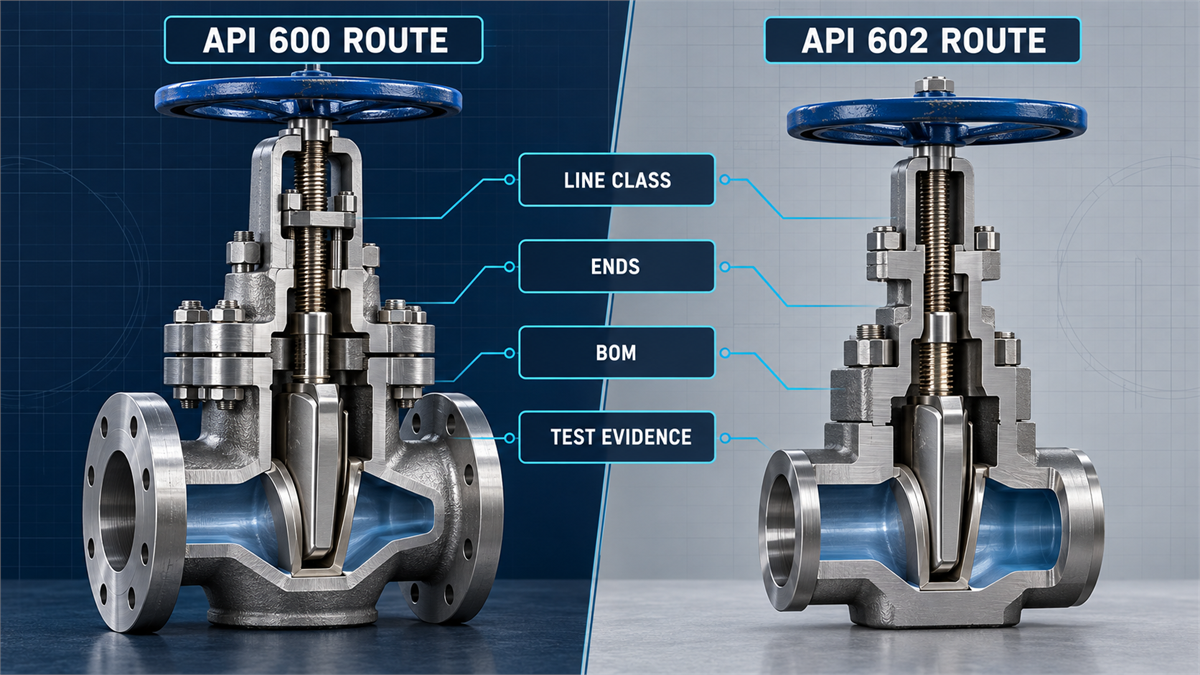
Short answer: API 600 and API 602 are different valve-scope standards, not competing quality grades. API 600 covers a heavy-duty series of bolted-bonnet steel gate valves with flanged or butt-welding ends. API 602 covers compact gate, globe and check valves through DN 100 (NPS 4). For a gate-valve RFQ, do not choose by the shortcut “API 600 equals cast” and “API 602 equals forged.” Start with the owner specification and line class, then lock the valve type, size, pressure class, end connection, body and bonnet route, trim, testing and document evidence.
API’s current public catalog lists API 600 as the 14th edition with Errata 1 and API 602 as the 11th edition. The purchase order must still state the project-controlled edition and any owner supplements. If the first question is which API valve family applies, use the API valve types guide before comparing individual suppliers.
API 600 vs API 602 Gate Valves at a Glance
| Review point | API 600 route | API 602 route |
|---|---|---|
| Published scope | Steel gate valves with flanged or butt-welding ends and bolted bonnets | Compact gate, globe and check valves for DN 100 (NPS 4) and smaller |
| Gate-valve procurement role | Common starting point for heavy-duty bolted-bonnet process gate valves | Common starting point for compact small-bore gate-valve packages |
| Valve types in the standard title | Gate valves | Gate, globe and check valves; this article narrows the comparison to gate valves |
| Size signal | Do not infer the ordered range from a supplier label; verify the offered size against the controlled standard and line class | The published scope is DN 100 (NPS 4) and smaller, but size alone does not select the standard |
| Body-manufacturing shortcut | Often associated in the market with cast-steel gate valves | Often associated in the market with compact forged-steel valves |
| What the shortcut cannot prove | Conformity, material route, pressure class, end connection, bonnet design, dimensions, tests, documentation or manufacturer licensing for the offered valve | |
| Best RFQ method | State the required standard and edition, line-item configuration and evidence; require the supplier to identify every deviation before award | |
The table is a scope map, not a substitute for either paid standard. It deliberately avoids copying dimensions, wall thicknesses, pressure-temperature tables or test acceptance values. Those requirements must come from the legally obtained contractual documents and the approved project datasheet.
Why “API 600 Is Cast and API 602 Is Forged” Is Incomplete
The cast-versus-forged shortcut is useful for finding the right catalog family, but it is not a purchase-order rule. The official API 600 title says “steel gate valves”; the API 602 title defines compact gate, globe and check valves by industry and size scope. Neither title authorizes a buyer to replace the full construction requirements with one manufacturing word.
A supplier may present a cast-steel product under an API 600 route and a forged compact product under an API 602 route. The bid still needs an offered bill of materials, manufacturing route, heat treatment where applicable, pressure-containing material specification, bonnet and body-joint details, end preparation, traceability and test basis. If any item is silent, the buyer has a commercial comparison gap rather than an approved equivalent.
Do not treat “forged” as automatically stronger or “cast” as automatically suitable for every larger line. Required wall sections, pressure-temperature capability, material quality, NDE, welding controls, geometry and service conditions must be assessed together. API 600 and API 602 identify scope; they do not rank one valve as a higher quality grade.
Size Alone Does Not Select the Standard
API 602 explicitly covers DN 100 (NPS 4) and smaller. That upper limit is a scope boundary, not an instruction that every NPS 4 gate valve must be API 602. A small valve may still be specified under another route because the owner’s piping class, end connection, face-to-face requirement, bonnet construction, material system or standardization policy controls the purchase.
Likewise, an offer described only as “API 600 gate valve” is incomplete. Confirm the size and class combination, the permitted ends, required bore or port condition, body and bonnet construction, wedge and seat arrangement, stem and packing system, operator and project documents. When the service moves into pressure-seal construction, compare that separate boundary in the API gate valve vs pressure seal gate valve guide.
API 602 also covers three valve types. A compact API 602 globe or check valve is not a gate valve just because it shares the standard number. For throttling versus isolation decisions, keep the valve function separate using the API gate valve vs API globe valve guide.
Let the Line Class Control the Selection
The safest starting point is the approved piping material specification or line class. It normally coordinates the service, design conditions, corrosion allowance, material family, pressure class, ends, branch philosophy, valve standard, testing and document requirements. A buyer should not reverse-engineer that system from a product-page title.
| Line-class input | Why it matters to API 600 vs API 602 | Required bid return |
|---|---|---|
| Valve type and duty | Confirms gate-valve isolation rather than globe-valve throttling or check-valve non-return duty | Valve type, flow direction if relevant and intended operating position |
| Size and pressure class | Tests the API 602 small-bore boundary and the available configuration under the selected route | Exact offered size/class and any excluded combination |
| End connection | Controls piping interface, welding scope, flange details and dimensional review | RF, RTJ, BW, SW or threaded detail only where permitted by the project |
| Material and service | Links pressure-containing materials, trim and soft goods to temperature, corrosion and process hazards | Complete BOM, material grades, compatibility statement and deviations |
| Bonnet and stem sealing | Separates bolted, welded, pressure-seal or special sealing requirements | Section drawing, gasket/packing/bellow details and qualification evidence where specified |
| Testing and inspection | Prevents a standard name from substituting for the required examination and acceptance plan | ITP, procedures, certificates, witness points and final test records |
For services where a quarter-turn valve is also being considered, the API gate valve vs API ball valve guide keeps the operating-function decision separate from the gate-valve standard decision.
Construction Interfaces to Freeze Before Quotation
Body, bonnet and manufacturing route
Ask the supplier to identify whether each pressure-containing part is cast, forged, fabricated or otherwise produced under the offered design. State the bonnet joint and gasket system. A bolted-bonnet API 600 route and a compact API 602 route can produce different envelopes, maintenance access needs and document sets even when the nominal size and class appear comparable.
Wedge, seats and stem
Define the required wedge form, body-seat construction, hardfacing or overlay requirement, stem arrangement, backseat where applicable, packing system and fugitive-emission scope. Avoid generic wording such as “standard trim.” The material pair, hardness, deposit process, examination and repair rules should match the project specification and offered drawing.
End connections and dimensions
State the exact flange facing, butt-weld preparation, socket-weld or threaded interface permitted by the line class. Project specifications may coordinate valve pressure-temperature requirements with ASME B16.34, face-to-face or end-to-end dimensions with ASME B16.10, flanges with ASME B16.5 and butt-weld preparation with ASME B16.25. Do not assume every document applies to every end type; list the applicable edition for the actual line item.
Operation and installation envelope
Record handwheel, gear or actuator scope, orientation, available clearance, stem travel, operating access and any extension. A compact valve can reduce envelope, but the buyer must still verify operability, maintenance access, weld clearance and insulation interfaces. Require a dimensioned GA rather than relying on a catalog photograph.
Testing, Traceability and Documentation
A standard reference is not the same as configuration-specific evidence. The final inspection file should trace the delivered valve to the approved datasheet, drawing, bill of materials and test plan. Use the valve testing and documentation checklist to build the document register.
| Evidence group | Minimum identity to check | Commercial risk if missing |
|---|---|---|
| Design basis | Standard, edition/addenda, owner supplement, datasheet and approved drawing revision | Supplier and buyer may be pricing different scopes |
| Material traceability | Valve tag or serial, heat numbers, pressure-containing parts, trim, bolting and certificates | Delivered materials cannot be tied to the approved BOM |
| Manufacturing and examination | Qualified procedures, NDE scope, acceptance basis and repair records where applicable | Critical examination may be assumed but not included |
| Pressure and functional tests | Valve identity, procedure, medium, calibrated instruments, sequence, results and acceptance basis | A generic certificate may not prove the offered configuration |
| Dimensions and interfaces | Ends, face-to-face/end-to-end, bore, operator envelope and project drawing | Site fit-up or replacement interchangeability can fail |
| Release package | ITP signatures, deviations closed, final data book index, manuals and preservation records | Shipment may arrive before contractual evidence is complete |
Exact inspection extent, pressure values, durations, leakage limits and acceptance criteria must be taken from the controlled contractual documents. This guide does not reproduce paid standard tables and does not create a test specification.
Fourteen RFQ Fields for Quote-Comparable Gate Valves
| # | RFQ field | Required buyer input or supplier return |
|---|---|---|
| 1 | Tag and quantity | Valve tag, line number, quantity, spares and delivery destination |
| 2 | Service conditions | Fluid, phase, solids, corrosion risks, design/operating pressure and temperature |
| 3 | Governing route | API 600, API 602 or other project-approved basis, with edition/addenda and precedence |
| 4 | Valve type and duty | Gate valve, normally full-open/full-closed duty and any special operating case |
| 5 | Size and class | Nominal size, pressure class and required pressure-temperature basis |
| 6 | Ends and dimensions | End type, facing/preparation, dimensional standard and replacement constraints |
| 7 | Body and bonnet | Manufacturing route, material, bonnet type, joint, gasket and bolting |
| 8 | Wedge and seats | Wedge form, seat construction, trim materials, hardfacing/overlay and acceptance |
| 9 | Stem sealing | Stem arrangement, packing, backseat, bellow or emissions requirement where specified |
| 10 | Operation | Handwheel, gear or actuator, orientation, torque/thrust basis and accessories |
| 11 | Examination | NDE, PMI, hardness, coating and special-process requirements with acceptance basis |
| 12 | Testing | Inspection/test standard, procedure, witness/hold points and required records |
| 13 | Deliverables | GA, section drawing, BOM, calculations, certificates, reports, IOM and data book |
| 14 | Bid return | Completed datasheet, compliance matrix, deviations, exclusions, lead time and option prices |
For a multi-tag package, combine these fields with the industrial valve inquiry checklist. Make every bidder return the same fields before comparing unit price.
Quotation Red Flags
- Standard name only. “API 600” or “API 602” without edition, configuration and deviations is not a complete technical offer.
- Automatic cast/forged equivalence. A body-manufacturing label does not prove the full standard route or line-class compliance.
- Size-only substitution. NPS 4 or smaller does not authorize changing the owner-specified standard.
- Mixed valve types. API 602 covers gate, globe and check valves; verify that every line item remains the required valve type.
- Unpriced document scope. NDE, witness points, material records, special tests and data books can disappear from a low bid unless itemized.
- Monogram language without proof. Referencing an API standard is not proof of an API Monogram license. If licensing or marking is contractual, verify the current licensee, facility and product scope through the official API directory before award.
Honiks Product and Category Routes
The HN100 API Cast Steel Gate Valve is a starting route for a cast-steel, bolted-bonnet gate-valve review. Its public product name and catalog content are not, by themselves, proof that every offered size, class, end or material conforms to API 600. Confirm the exact standard, edition, configuration, manufacturing source, tests and documents in the quotation.
The HN69 Forged Steel Bellow Seal Globe/Gate Valve is a starting route for compact forged bellow-seal inquiries. It covers more than one valve type, and a bellow-seal ANSI product family is not automatically an API 602 gate valve. The offered gate configuration, API scope, end connection, bellow qualification, materials and inspection plan require separate confirmation.
Browse the Gate Valve category, Forged Steel Valves category and API Valves category for other starting routes. Honiks can coordinate specification clarification, source matching, inspection planning and export documentation with qualified partner factories. Review the quality control process and factory capability and project support; final manufacturing source, qualification scope and evidence depend on the selected offer and approved project requirements.
Frequently Asked Questions
Are API 600 and API 602 the same quality level?
No. They are different scope standards, not quality grades. The correct route depends on the owner specification, line class, valve type, size, ends, construction and required evidence.
Does API 600 always mean a cast valve and API 602 always mean a forged valve?
Do not use “always.” Cast API 600 and forged API 602 are common market routes, but the purchase decision must be based on the controlled standard and the offered BOM, drawing, manufacturing route and compliance matrix.
Should every NPS 4 gate valve be specified to API 602?
No. NPS 4 is within the published API 602 size scope, but the line class and project specification may require another gate-valve route. Size is one selection input, not the only one.
Can an API 602 gate valve replace an API 600 gate valve?
Only when the owner or responsible engineer approves the substitution after every applicable interface is shown equivalent or acceptable. Standard scope, ends, dimensions, construction, materials, tests and documents must all be reviewed.
Does an API standard reference prove API Monogram authorization?
No. Product-standard conformity language and API Monogram licensing are different claims. When Monogram marking is required, verify the current license, facility and licensed product scope in the official API directory.
What should I send for an API 600 or API 602 gate-valve quotation?
Send the line class, valve list, service and design conditions, standard and edition, size/class, ends, materials, bonnet and trim requirements, operator, inspection/test plan, document register, quantity, destination and required delivery date.
Request an API Gate Valve Scope Review
Contact Honiks with the fourteen RFQ fields above. Ask for a completed datasheet, marked drawing, BOM, standard-and-edition statement, deviations, inspection plan and document schedule before comparing commercial offers.