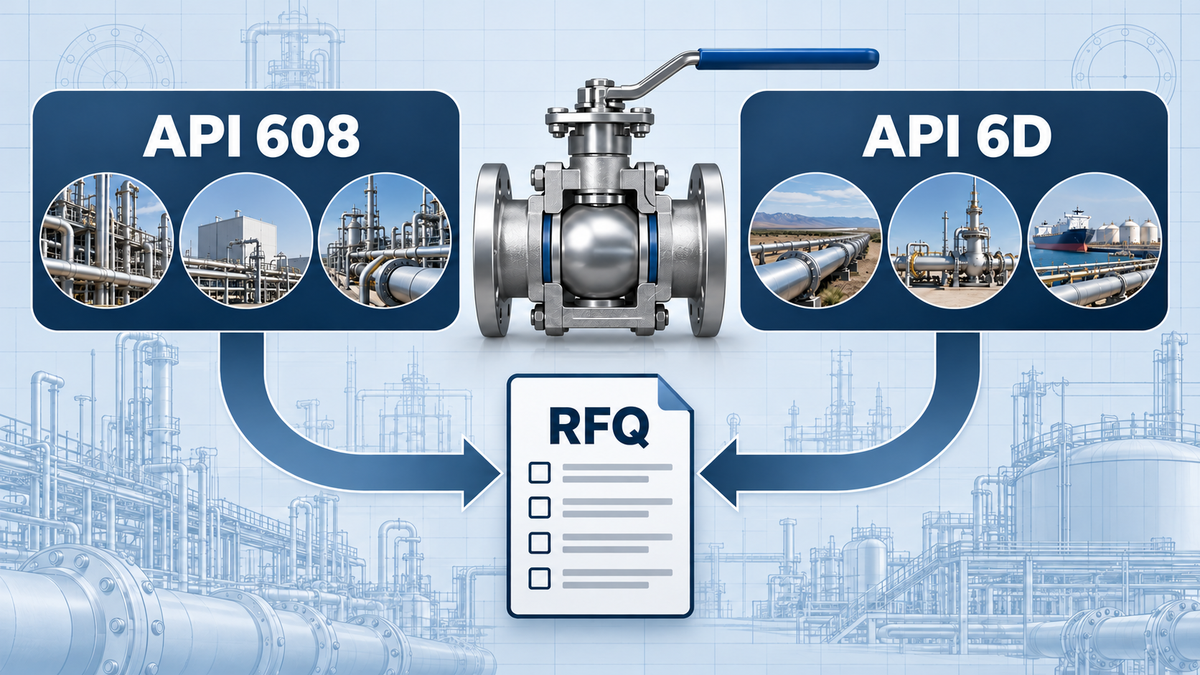
Short answer: API 608 and API 6D are different valve-standard scopes, not two quality grades in which one is automatically “better.” API 608 is a metal ball valve standard for petroleum, petrochemical and industrial applications within its stated valve, end-connection, size and pressure-class limits. API 6D is the API pipeline-valve specification. Start with the governing piping or owner specification, then confirm the offered valve’s construction, bore, ends, materials, testing, documentation and applicable edition. A quotation that says only “API compliant” is not complete enough for technical comparison.
API 608 vs API 6D Ball Valves: Quick Comparison
The table below is a purchasing screen, not a substitute for the current standards. The order should identify the applicable edition and any addenda because a project may use a different contractual edition from the latest publication.
| Buyer question | API 608 direction | API 6D direction | What to put in the RFQ |
|---|---|---|---|
| Primary scope signal | Metal ball valves for petroleum, petrochemical and industrial applications within the standard’s defined limits | Valves for pipeline project service under the pipeline-valve specification | Governing piping code, owner specification, standard edition and project location |
| Valve family | Ball valves | Pipeline-valve scope; do not assume every requirement is identical to a ball-valve-only standard | Ball valve type, floating or trunnion/fixed construction, and required service |
| Ends, size and class | Covered combinations are limited by the published scope | Pipeline project range must be checked against the current specification and owner requirements | NPS/DN, ASME Class/PN, RF/RTJ/BW/threaded/socket-weld as applicable, and mating-pipe data |
| Bore and flow path | The offered bore must be stated; the standard name alone does not select it | Pipeline pigging, flow and project requirements can make the bore decision critical | Full or reduced bore, minimum bore if controlled, and piggability when required |
| Testing and special requirements | Confirm the specified inspection, pressure/leakage testing and any separate qualification evidence | Confirm pipeline-project testing, documentation and supplementary purchaser requirements | Test standard, medium, pressure, direction, acceptance, witness points and required records |
| Certification claim | A reference to either document is not, by itself, proof of an API Monogram license or that a Monogram mark applies to the offered item | Ask separately for the manufacturer, facility, license scope and product-specific marking/evidence when required | |
What Does API 608 Cover?
API Standard 608 is titled Metal Ball Valves—Flanged, Threaded, and Welding Ends. API’s current public listing describes it as a standard for metal ball valves used in petroleum, petrochemical and industrial applications and defines covered combinations of end connection, nominal size and pressure class. As of October 2026, the API Webstore lists the seventh edition, published in April 2025.
The word “metal” in the title should not be read as a promise of a metal-to-metal seat. The inquiry must still state the required seat material and sealing arrangement. For that separate decision, use the metal seated vs soft seated ball valve guide.
API’s public description also connects API 608 with ASME B16.34 requirements for relevant valves. That does not remove the need to specify face-to-face dimensions, flange or welding-end references, corrosion allowance where applicable, material grades and project deviations. The current ASME B16.34 edition should be checked against the project’s contractual edition rather than assumed.
What Does API 6D Cover?
API’s current catalog identifies API Specification 6D as its pipeline-valve specification. The 25th edition is current in the API sources reviewed for this guide, and API lists later addenda, including Addendum 3 from March 2025. A buyer should therefore state both the edition and applicable addenda instead of writing only “latest API 6D.”
For a ball valve, an API 6D project direction commonly signals that the valve will be reviewed as part of a pipeline system and its project documentation. It does not automatically choose floating versus trunnion construction, seat material, bore, operator, coating, low-temperature trim, fire-test evidence or a particular isolation arrangement. Those items remain part of the datasheet and purchase specification.
Pipeline duty can also introduce owner-specific requirements that go beyond a standard title. Confirm operating philosophy, buried or above-ground installation, pigging, pressure differential, actuation, emergency shutdown interfaces, preservation, shipment and documentation before comparing bids.
Is API 6D Better or More Stringent Than API 608?
That is the wrong decision test. The two documents serve different scopes. A pipeline project may point to API 6D; a process or industrial ball-valve specification may point to API 608. The correct choice is the document required by the governing project and applicable to the offered valve—not the document with the larger number or the longer checklist.
Do not accept a blanket statement that one valve is “dual certified” without the scope behind it. Ask the supplier to identify the exact standard editions, the offered size/class/end combination, declared deviations, test basis and documents that will be delivered. If more than one document is invoked, the quotation should explain how conflicts or purchaser supplements are resolved.
How Should a Buyer Choose the Standard Scope?
1. Start with the governing project documents
Check the piping material specification, valve datasheet, line class, owner standard and purchase requisition. These documents may already name API 608, API 6D, ASME B16.34 or a combination with purchaser additions. A supplier should not replace that basis with a preferred catalog standard without a documented technical deviation.
2. Identify process-plant or pipeline context
For refinery, petrochemical or general industrial process piping, API 608 may be the direct ball-valve product-standard route when the offered configuration is inside its scope. For transmission, terminal or other pipeline-system projects, API 6D may be the governing route. Mixed facilities can contain both contexts, so one project can require different standard bases for different valve tags.
3. Verify the offered configuration is inside scope
Match valve type, nominal size, pressure class, body construction and end connection to the invoked standard. Then identify the required bore, floating or trunnion/fixed ball support, seat construction and operation method. The floating vs fixed ball valve comparison explains the construction decision separately from the standard decision.
4. Add service-specific requirements
State the medium, concentration, solids, operating and design temperatures, pressures, maximum differential pressure, cycles and upset conditions. If the project requires fire-test, fugitive-emissions, sour-service, anti-static, cavity-relief, double-isolation or other evidence, name the governing requirement and required deliverable. Do not infer these from “API 608” or “API 6D” alone.
5. Define the acceptance evidence
Specify material certificates, pressure and leakage test records, NDE, coating or hard-facing records, dimensional reports, actuator data, marking review, inspection and approved drawings as applicable. The valve testing and documentation checklist can be used to structure the document register.
Three Typical Specification Scenarios
Process or petrochemical unit
The piping class calls for a metal ball valve in a covered end, size and class range. API 608 may be the appropriate product-standard starting point, with ASME and project references added for ratings, dimensions, ends, testing and materials. The buyer still defines seat compatibility, shutoff acceptance, actuation and documentation.
Cross-country or terminal pipeline
The owner specification identifies API 6D and adds pipeline-specific functional, inspection and document requirements. The buyer confirms bore and pigging needs, pressure differential, above-ground or buried installation, actuator interfaces, preservation and any project qualification evidence. For related application questions, see the tank farm ball valve selection notes.
Mixed project package
A terminal or processing complex may have pipeline block valves, unit isolation valves and utility valves in the same requisition. Do not force every tag into one standard label. Build a valve schedule that assigns the governing standard, owner supplement and acceptance documents by tag or line class, then ask suppliers to quote and list deviations on that same basis.
After the governing scope is selected, convert it into quote-comparable line-item data with the API 6D ball valve RFQ checklist. Keep the passage decision separate: the full-bore vs reduced-bore ball valve guide explains which flow, pigging and drawing evidence should be stated rather than inferred from the standard name.
RFQ Checklist for API 608 or API 6D Ball Valves
A useful RFQ makes competing offers comparable. Start with the broader industrial valve inquiry checklist, then include these standard-scope fields for each line item:
- Valve tag, quantity, service and installation location
- Governing product standard, edition, addenda and owner specification
- NPS/DN, ASME Class/PN, body pattern and end connection
- Floating or trunnion/fixed construction; full or reduced bore; piggability if required
- Body, closure, stem, seat, seal, packing and bolting materials
- Medium, concentration, solids, operating/design temperature and pressure
- Maximum differential pressure and operating/cycling conditions
- Manual, gear, pneumatic, electric or hydraulic operation and required fail position
- Pressure/leakage test basis, acceptance criteria and witness or hold points
- Required fire-test, emissions, sour-service, anti-static or other qualification evidence
- Material certificates, NDE, coating records, test reports and approved drawings
- API Monogram marking and facility license scope only when the project explicitly requires them
- Required deviation list, document schedule, delivery terms and inspection release
Common API 608 and API 6D Specification Mistakes
- Writing only “API compliant.” Name the document, edition, addenda, offer scope and deviations.
- Treating API 6D as a premium grade of API 608. Select by the governing application and project documents.
- Assuming “metal ball valve” means metal seated. State the actual seat material and sealing arrangement.
- Using the standard name to select floating or trunnion construction. Decide construction from the project duty and offered range.
- Assuming a standard reference proves fire testing or emissions qualification. Request the separate evidence required by the project.
- Confusing standard conformance with API Monogram licensing. Verify facility, license scope and marking separately.
- Ignoring the contractual edition. “Latest” may not match the edition named in an approved project specification.
- Comparing prices before normalizing deviations. A lower quotation may exclude testing, materials, documents or inspection that another bid includes.
Honiks Ball Valve Routes for Technical Review
Honiks product pages are starting points for a project review; they are not evidence that every listed size and option meets every edition or owner supplement. The offered configuration and documents must be confirmed before order.
| Route | Documented direction | Use in the first review |
|---|---|---|
| HN105 Floating Ball Valve | Floating construction; Class 150, 300 and 600 catalog route; RF or butt-welded options depending on configuration | Screen compact quarter-turn isolation requirements, then verify standard scope, size, seat, test and documents |
| HN106 Fixed Ball Valve | Fixed/trunnion-supported construction with a broader class and size route in the current catalog data | Screen larger-size or higher-class requirements, then verify the exact offered end, bore, standard and project evidence |
For broader navigation, review the Ball Valves category, the API Valves category and the API valve types guide. Honiks works with qualified partner factories to coordinate specification matching, inspection and export documentation; review the quality control process and factory capability and project support before defining the inspection plan.
Frequently Asked Questions
Can a ball valve be specified to both API 608 and API 6D?
A purchaser can invoke more than one applicable document, but the quotation must confirm that the exact offered configuration is within scope and explain editions, supplements, conflicts and deviations. Do not accept a “dual standard” label without that evidence.
Does API 6D automatically mean a trunnion-mounted ball valve?
No. Do not select the support arrangement from the standard number alone. State the required construction and verify it against size, pressure, bore, torque and project requirements.
Does API 608 require a metal seat?
The title “metal ball valves” is not enough to define a metal-to-metal seat. The RFQ and offered bill of materials should identify the seat and seal materials, service limits and leakage acceptance.
Is an API standard reference the same as an API Monogram?
No. API describes the Monogram as a voluntary licensing program. When a marked product is required, verify the licensed manufacturer and facility, the applicable license scope and whether the offered product is eligible for the mark.
Which edition should be written in the purchase order?
Use the edition and addenda required by the approved project documents. If the buyer intends the current edition, identify it explicitly and resolve the change with the supplier rather than relying on the word “latest.”
What should be checked before comparing two quotations?
Normalize the standard basis, size/class/end, bore, construction, materials, seat, testing, qualification evidence, inspection, documentation, deviations and actuator scope. Price comparison before technical normalization can hide major exclusions.
Send the Valve Schedule for a Standards-Scope Review
Send the valve tags, service conditions, governing specifications, edition/addenda, size, class, ends, bore, construction, materials, test requirements and document list. Honiks can compare the inquiry with available configurations, coordinate clarification with qualified partner factories and identify items that require confirmation before quotation.
Contact Honiks with the valve datasheet, piping class or line-item schedule for review.