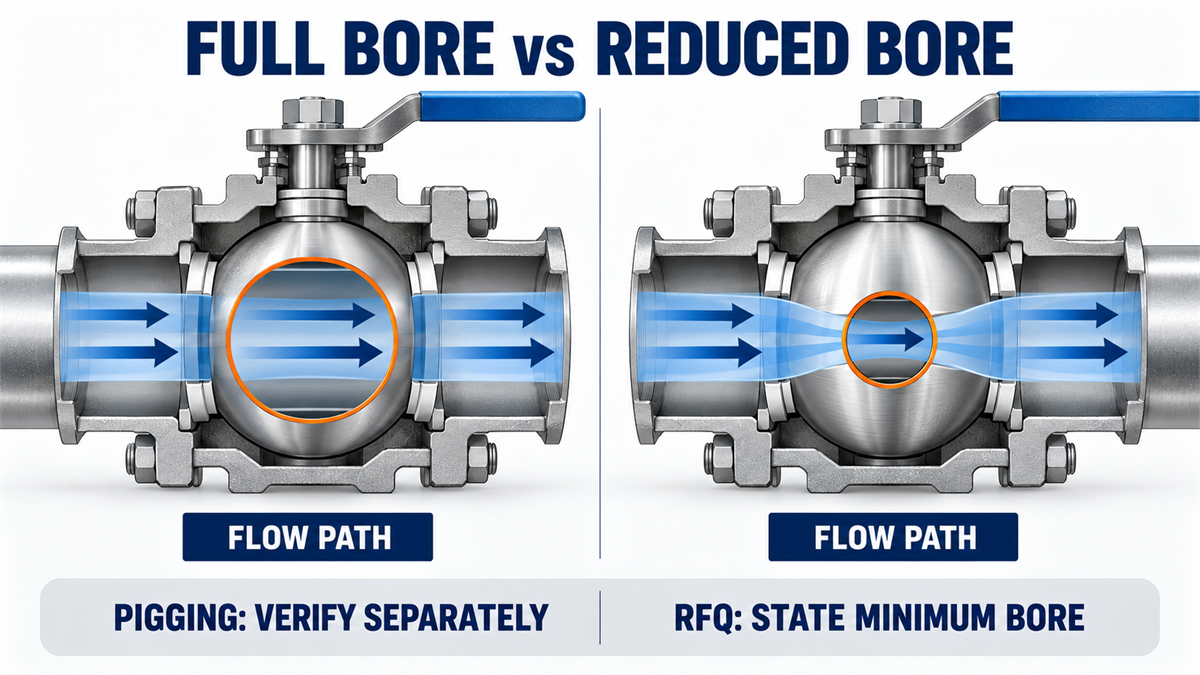
Short answer: choose a full-bore ball valve when the project needs the least practical flow restriction, an explicitly verified pig passage, or a line-cleaning route that depends on a near-line-size opening. Choose a reduced-bore ball valve when the hydraulic review accepts the smaller passage and the project values a potentially smaller, lighter or more economical valve package. Neither label completes the selection: the RFQ should state the required minimum passage, flow data, pig or cleaning criteria, service conditions and the evidence the supplier must return.
“Full bore,” “full port,” “reduced bore” and “reduced port” are useful commercial descriptions, but they are not substitutes for the offered drawing and dimensional schedule. The governing product standard, valve size, pressure class, body construction and manufacturer design determine what can be supplied. If the standard scope is still undecided, first review the API 608 vs API 6D ball valve comparison; the bore decision comes after that scope question has been resolved.
Full Bore vs Reduced Bore Ball Valve: Decision Snapshot
| Decision point | Full bore tends to fit when | Reduced bore may fit when | What must be verified |
|---|---|---|---|
| Flow path | Pressure-loss allowance is tight or the buyer wants a passage close to the connecting line | The system calculation accepts the added local resistance | Offered bore, flow coefficient or loss data, and the calculation case |
| Pigging | The line must pass a defined pig and the complete passage is designed for it | Pig passage is not required, or a project-approved cleaning method is used | Pig geometry, minimum passage, transitions, seat intrusion and supplier confirmation |
| Solids and cleaning | A wider passage supports the project’s flushing, draining or solids-handling strategy | The medium is clean enough and the smaller passage is acceptable | Particle data, velocity, erosion risk, cavity behavior and cleaning procedure |
| Envelope and operation | Flow and passage requirements outweigh package reduction | A smaller ball and body may reduce package size, weight or operating demand | Actual GA drawing, weight, torque and actuator sizing—not assumptions |
| Commercial comparison | The project is willing to pay for the larger passage where it creates value | Lifecycle review supports a lower first-cost or smaller package | Like-for-like materials, tests, documents, actuator and exclusions |
This table is a screening tool, not a universal rule. A full-bore design can still have an unsuitable transition for a particular pig, and a reduced-bore design can still be the correct engineering choice in a well-sized system. The final selection belongs to the project datasheet and hydraulic, mechanical and operating review.
What the Bore Terms Do—and Do Not—Tell You
Nominal valve size is not the measured flow passage
NPS or DN identifies the nominal connection size. It does not, by itself, state the smallest clear opening through the ball, seats and adjacent internal transitions. A buyer who needs a controlled passage should request the minimum offered bore and the drawing location at which it is measured. That keeps a nominal-size description from being mistaken for a dimensional guarantee.
Full bore does not automatically mean piggable
Piggability is a system requirement. It depends on the pig type and dimensions, bore continuity, seat and seal intrusion, body transitions, end-connection alignment, weld preparation, valve orientation and neighboring pipeline geometry. “Full bore” is therefore a useful starting point, but not a complete pig-passage acceptance statement. The project should define the pig and ask the supplier to confirm the complete offered route.
Reduced bore is not one universal reduction
Do not assume that every reduced-bore valve is exactly one nominal size smaller internally. Designs vary by product family, size, class and manufacturer. Record the actual proposed passage and compare bids using the same dimensional basis. A label without the offered bore can hide technically different quotations.
Bore choice does not select ball support or seat material
Floating versus fixed or trunnion-supported construction describes how loads are carried; it does not answer the bore question. The floating vs fixed ball valve guide treats that decision separately. Likewise, full or reduced bore does not determine whether a soft or metal seat is suitable. Review media, temperature, shutoff, wear and torque through the metal seated vs soft seated ball valve guide.
A Five-Decision Workflow for Bore Selection
1. Fix the governing service cases
Start with design and operating pressure and temperature, fluid composition and phase, normal and maximum flow, density and viscosity where relevant, credible upset cases, shutoff differential, solids content and operating frequency. A bore decision made from nominal size alone ignores the cases that may control pressure loss, velocity, erosion or actuator sizing.
2. Set a hydraulic acceptance criterion
State what the system can accept: a project pressure-drop limit, minimum downstream pressure, pump or compressor margin, maximum velocity where the owner uses one, or a required supplier flow coefficient. Then calculate the line as a system. Do not apply an internet percentage for “full bore savings” or “reduced bore loss” to every fluid and size.
3. Define pigging, flushing and cleaning as functions
If the line is pigged, identify the pig type, body diameter, sealing or cleaning elements, minimum acceptable passage and any gauging criteria. If the line is not pigged, still define flushing, draining, decontamination and maintenance needs. A wider passage can be valuable for reasons other than a production pig, while some services do not benefit enough to justify it.
4. Compare the complete mechanical package
Request the offered GA drawing, face-to-face basis, bore, ball and stem design, body arrangement, mass, support loads, operating torque and actuator selection. A reduced passage may allow a more compact design, but the actual result depends on class, materials, construction and design rules. Never award a bid based on an assumed weight or torque reduction.
5. Tie every claim to acceptance evidence
For each critical requirement, specify what proves it: approved drawing, dimensional report, flow data, calculation, pig-clearance statement, material certificate, test report or inspection record. The valve testing and documentation checklist helps turn these items into a reviewable document register.
How to Compare Flow and Pressure Loss Without Invented Percentages
A fully open ball valve is often selected for a relatively direct flow path, but the difference between two offered valves cannot be reduced to the words “full” and “reduced.” Pressure loss depends on the actual internal geometry and the operating point. Fluid properties, pipe size, flow rate, fittings and other equipment may dominate the system result.
| Buyer question | Supplier return | Engineering use |
|---|---|---|
| What is the minimum clear bore? | Dimension and location on the offered sectional or GA drawing | Confirms the actual restriction used in the review |
| What flow data are available? | Cv, Kv or loss data with the stated basis and valve position | Supports pressure-drop comparison at the project operating cases |
| Are there internal steps or transitions? | Section view and end-to-bore transition details | Supports turbulence, cleaning and pig-passage review |
| What case controls actuator sizing? | Break, running and end torque basis, differential pressure and design margin | Separates hydraulic passage choice from actuator assumptions |
| What is excluded from the calculation? | Fluid-property assumptions, adjacent pipe/fittings and any project data still open | Prevents apparently precise results from hiding different inputs |
Use the same fluid cases and calculation method for every bid. Where energy use is commercially important, compare the valve’s incremental loss over the expected operating profile, not only at one convenient flow point. Where the valve is rarely flowing, other factors—piggability, isolation, maintainability, footprint or delivery—may deserve more weight.
Pigging Compatibility Requires a Separate Verification
The most common specification error is to write “full bore, therefore piggable.” A safer approach is to create a pigging interface sheet and obtain written confirmation against the offered valve. The line owner or pig specialist should retain responsibility for the system-level pigging decision.
| Pigging input | Why the valve supplier needs it | Expected evidence |
|---|---|---|
| Pig type and purpose | Cleaning, batching, gauging and inspection tools can have different passage needs | Named pig or dimensional envelope referenced in the offer |
| Maximum body and sealing-element dimensions | Nominal pipeline size alone does not define the tool envelope | Clearance review against the minimum offered passage |
| Allowed internal steps and discontinuities | Seats, transitions and weld interfaces can affect passage | Section drawing with critical transition dimensions |
| Valve orientation and travel direction | Some system risks depend on installed orientation and approach | Installation note and any directional limitation |
| Gauge or proving requirement | The owner may require a physical or documented acceptance step | Agreed inspection or dimensional record before shipment |
| Adjacent pipeline interfaces | A suitable valve cannot make incompatible reducers, bends or welds piggable | System review by the responsible pipeline engineer |
For terminal and pipeline context, the tank farm ball valve selection guide shows why operating duty and line layout should accompany the valve label. It does not replace the project-specific pigging review.
When Each Bore Route Usually Deserves Review
Full bore is a strong candidate when passage performance is controlling
- The line must pass a defined pig, gauge or inspection tool and the offered geometry can be verified.
- The hydraulic model shows that local restriction materially affects system performance.
- Flushing, draining or process-cleaning strategy benefits from a wider continuous passage.
- The service contains solids and the project wants to minimize internal restriction, subject to a separate erosion review.
- The owner standard or approved datasheet explicitly requires the dimensional route.
Reduced bore deserves review when the smaller passage is acceptable
- The hydraulic calculation demonstrates adequate margin at all relevant operating cases.
- The line has no pig-passage requirement and cleaning procedures accept the offered geometry.
- Package envelope, mass, support load, actuator size, availability or first cost is commercially important.
- The project can verify that higher local velocity does not create unacceptable noise, erosion, flashing or process effects.
- The offer remains compliant with the governing specification and all functional requirements.
Neither route should be selected from first cost alone
A cheaper valve can create operating cost or maintenance constraints; a larger passage can add cost and envelope without measurable project benefit. Compare lifecycle consequences using the actual operating profile, inspection strategy, spares, actuator package and installation constraints. The right answer can differ by tag within the same project.
RFQ Fields for a Quote-Comparable Bore Decision
Use the following fields in the datasheet or bid clarification. For a mixed valve package, place them inside the broader industrial valve inquiry checklist so bore is evaluated with materials, service, tests and documents.
| # | RFQ field | Buyer input or required supplier return |
|---|---|---|
| 1 | Governing documents | Product standard, edition/addenda, piping class, owner specification and precedence |
| 2 | Nominal size and class | NPS/DN, pressure class or rating basis and end connection |
| 3 | Bore route | Full or reduced bore, or supplier proposal subject to hydraulic review |
| 4 | Minimum passage | Required dimension/tolerance basis and offered measured location |
| 5 | Service cases | Fluid, phase, design/operating pressure and temperature, flow and upset cases |
| 6 | Hydraulic evidence | Required Cv/Kv or loss data and project acceptance criterion |
| 7 | Pigging or cleaning | Pig envelope, passage criteria, flushing and maintenance requirements |
| 8 | Solids and erosion | Particle data, expected velocity concern and required material/trim review |
| 9 | Construction | Floating or fixed/trunnion-supported route, body arrangement and ends |
| 10 | Materials and seats | Body, closure, ball, stem, seat, seals, packing and bolting requirements |
| 11 | Operation | Manual or actuated package, differential pressure, torque basis and margin |
| 12 | Dimensions and mass | GA, face-to-face basis, centerline height, weight and support interface |
| 13 | Testing | Production test basis, supplementary tests, witness points and acceptance records |
| 14 | Qualification evidence | Only project-required fire, fugitive, sour, low-temperature or other evidence |
| 15 | Bid response | Completed datasheet, deviations, exclusions, option prices and document list |
| 16 | Configuration identity | Model and drawing revision tying all returned data to the priced valve |
Normalize bids before ranking price. Put full- and reduced-bore options on separate lines where both are acceptable, and require each line to include the offered bore, flow data, drawing, weight, torque basis, actuator, tests and documentation. That prevents a low price from winning only because it represents a smaller passage or incomplete package.
Honiks Product and Review Routes
The HN106 Fixed Ball Valve is a relevant fixed/trunnion-supported review route with full- or reduced-bore options described as project-dependent. The exact bore, size, class, standard, body construction, ends, materials, seats, testing and document scope must be confirmed for the offered configuration. The HN105 Floating Ball Valve provides a floating-ball route for a separate size, pressure and service review; its suitability cannot be inferred from the family name alone.
Browse the Ball Valves category, API Valves category and API valve types guide when the inquiry includes more than one construction or standards route. Honiks coordinates clarification, inspection planning and export documentation with qualified partner factories. Review the quality control process and factory capability and project support; final manufacturing source, compliance, qualification scope and documentation depend on the selected offer, approved drawings and project requirements.
Frequently Asked Questions
Is a full-bore ball valve always the same size internally as the pipe?
Do not accept that as a dimensional guarantee. Nominal pipe and valve sizes do not state every internal diameter. Request the minimum offered passage, transition details and the governing dimensional basis.
Does full bore always mean lower pressure drop?
A wider, smoother passage will generally reduce local restriction relative to a smaller passage of otherwise comparable geometry, but a project decision needs offered flow data and a system calculation. There is no universal percentage that applies to every valve, fluid and operating point.
Can a reduced-bore ball valve be used in a pipeline?
It may be suitable when the governing specification permits it and hydraulic, pigging, cleaning, velocity and operating reviews accept the offered passage. State those requirements explicitly rather than relying on the word “pipeline.”
Is every full-bore ball valve piggable?
No. Verify the complete valve passage against the actual pig or tool envelope, including transitions, seats, end interfaces and installation orientation. Piggability is a system conclusion, not an automatic synonym for full bore.
Does reduced bore always make the valve smaller and cheaper?
It can support a smaller or more economical package, but the result is not guaranteed. Size, class, materials, body construction, testing, actuator and supplier design all influence dimensions, mass and price. Compare returned data.
What should I send for a bore-selection review?
Send the governing specifications, line size/class, service cases, required flow or pressure-loss criterion, pig or cleaning data, solids information, materials, valve construction, actuation, tests, quantity and delivery destination. Mark open points for supplier proposal.
Request a Full- or Reduced-Bore Valve Review
Contact Honiks with the valve list and the 16 RFQ fields above. Ask for the offered bore and drawing, flow data, pigging statement where required, torque basis, actuator package, tests, deviations and document list on the same quotation line. The final selection should be made against the project specification and approved configuration—not the bore label alone.