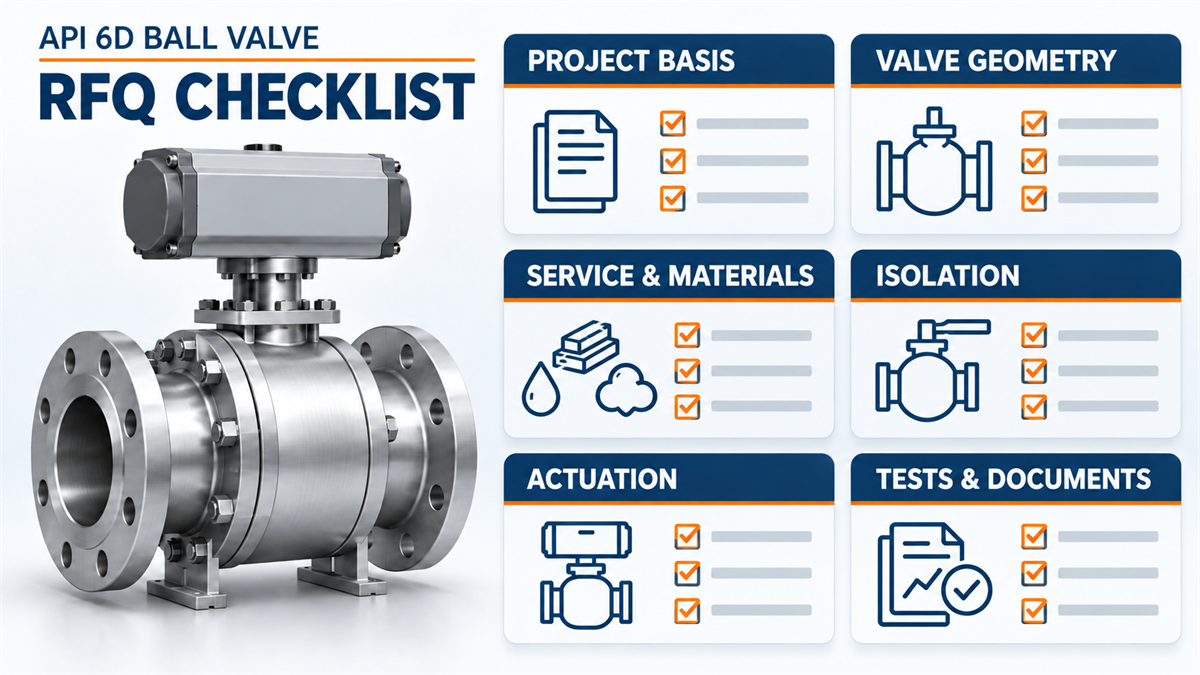
Short answer: an API 6D ball valve RFQ should not stop at size, pressure class and body material. To receive technically comparable bids, state the project basis, valve geometry, service conditions, materials, isolation functions, actuation, testing and document deliverables as separate fields. The words “API 6D” do not automatically select full bore, a piggable passage, trunnion support, DBB or DIB performance, a cavity-pressure-relief arrangement, fire-test evidence or API Monogram marking. This 36-field checklist turns those assumptions into an auditable inquiry.
This guide starts after the project has selected API 6D as the intended product-standard scope. If that decision is still open, first use the API 608 vs API 6D ball valve guide. For a mixed valve package that includes gate, globe, check or non-pipeline items, begin with the broader industrial valve inquiry checklist.
Why “API 6D Ball Valve” Is Not a Complete RFQ
API 6D establishes a pipeline- and piping-valve specification context, but a supplier still needs project inputs to select and price a particular valve. Two quotations can both mention API 6D while differing in bore, body construction, seat arrangement, materials, test scope, documentation, actuator package and excluded services. Comparing their prices before normalizing those differences can reward the least complete interpretation rather than the best technical offer.
The safest buying sequence is: identify the governing documents, define the service, state each required function, name the evidence needed to accept that function, and require every bidder to list deviations. A standard reference is one input in that sequence, not a substitute for a valve datasheet. The API valve types guide provides wider context when the valve family itself is still being selected.
API 6D Ball Valve RFQ Checklist: 36 Fields
Use the following fields for every tag or group only genuinely identical tags. Write “supplier to propose” where engineering input is needed, but do not leave the decision invisible. A clear proposal field is reviewable; a silent assumption is not.
1. Project and Contract Basis
| # | RFQ field | What the buyer should state | Why it matters |
|---|---|---|---|
| 1 | Tag and quantity | Tag number, line number, quantity and whether spares are separate | Prevents different line items or spare obligations from being combined |
| 2 | Governing document order | Purchase specification, datasheet, piping class, owner standard and precedence rule | Lets bidders resolve conflicting requirements on the same basis |
| 3 | API 6D edition and addenda | The exact contractual edition and applicable addenda, not only “latest” | Fixes the compliance baseline for bid and manufacture |
| 4 | Companion references | Applicable piping code, ASME references and project supplements | Separates product-standard scope from ratings, ends and project rules |
| 5 | Service and installation | Pipeline or station duty, above-ground or buried location, indoor or outdoor exposure | Influences construction, coating, extensions, operation and preservation |
| 6 | Bid response format | Completed datasheet, compliance matrix, deviations, exclusions and option pricing | Makes supplier offers comparable before price ranking |
2. Valve Geometry and Construction
| # | RFQ field | What the buyer should state | Why it matters |
|---|---|---|---|
| 7 | Nominal size and pressure class | NPS or DN and the required class or rating basis for each tag | Defines the starting envelope but not the full design |
| 8 | Ball support | Floating, trunnion/fixed, or supplier proposal subject to project review | Changes load path, torque, size suitability and offer basis |
| 9 | Body construction | Side-entry, top-entry, welded-body, split-body or approved alternatives | Affects maintenance access, leakage paths, weight and fabrication route |
| 10 | Bore requirement | Full or reduced bore, any controlled minimum bore and allowed tolerance basis | The standard name alone does not select the offered flow passage |
| 11 | End connection | Flanged facing, butt-weld preparation or other approved end details | Controls dimensional fit, welding scope and installation interface |
| 12 | Face-to-face and orientation | Required dimensional basis, flow direction if relevant and installation orientation | Prevents fit-up conflicts and unreviewed directional assumptions |
Floating versus fixed describes ball support; it does not by itself establish API 6D scope or every isolation function. Review the construction decision separately in the floating vs fixed ball valve comparison.
3. Service Conditions and Materials
| # | RFQ field | What the buyer should state | Why it matters |
|---|---|---|---|
| 13 | Fluid composition and phase | Medium, concentration, gas/liquid phase, water content and known contaminants | Supports material, seal and corrosion review |
| 14 | Pressure and temperature cases | Design and operating values, minimum temperature and credible upset cases | A single normal operating point can hide the limiting condition |
| 15 | Differential pressure | Maximum operating and shutoff differential in each relevant direction | Influences seat load, break torque and actuator sizing |
| 16 | Solids and erosion | Particle type, size or concentration where known, plus erosion or flashing concerns | Changes seat, coating and hard-facing review |
| 17 | Metallic materials | Body, closure, ball, stem, seat carrier, bolting and trim material requirements | A body grade alone does not define the pressure-containing and wetted package |
| 18 | Soft goods and seat interface | Seat, seal, packing and gasket materials; soft or metal seat direction; compatibility limits | Links shutoff expectations to the actual service rather than a generic label |
Seat construction is a separate engineering choice. Use the metal seated vs soft seated ball valve guide to review media, temperature, shutoff, wear and torque before fixing field 18.
4. Flow, Isolation and Pressure Management
| # | RFQ field | What the buyer should state | Why it matters |
|---|---|---|---|
| 19 | Pigging requirement | Whether the line is piggable, pig type, required passage and any project gauge criteria | “Full bore” and “piggable” should not be treated as interchangeable assumptions |
| 20 | Sealing direction | Unidirectional or bidirectional expectation and pressure cases to be demonstrated | Prevents disagreement over which direction an isolation claim covers |
| 21 | DBB or DIB function | The project’s functional definition, seat arrangement and required pressure sequence | A three-letter label is not enough to compare different seat concepts |
| 22 | Bleed and drain arrangement | Required ports, valves, plugs, orientation and access for operation or testing | Clarifies what is included in the assembled supply |
| 23 | Cavity-pressure management | Required relief path, direction, set logic if separately controlled and evidence to provide | Turns an assumed safety function into a reviewable offered arrangement |
| 24 | Special qualification evidence | Fire, fugitive-emissions, sour, low-temperature, anti-static or other project evidence when required | Requires the report or certificate to match the offered design scope |
Pipeline and terminal duty can make fields 19–24 commercially decisive. The tank farm ball valve selection guide adds application context, but the RFQ must still define each required function for the actual tag.
5. Operation, Actuation and Accessories
| # | RFQ field | What the buyer should state | Why it matters |
|---|---|---|---|
| 25 | Operating method | Lever, gearbox, electric, pneumatic or hydraulic actuation | Defines the basic operating package and interfaces |
| 26 | Fail action | Fail open, fail closed, fail in place or no fail action, with energy-loss scenario | Avoids ambiguous actuator behavior during loss of utilities |
| 27 | Utility and control signals | Power, air or hydraulic supply; control voltage; signals and communication protocol | Prevents incompatible accessories and controls |
| 28 | Stroke time | Required opening and closing time, including any minimum or maximum limits | Links process response to surge and actuator selection review |
| 29 | Torque basis | Pressure, temperature, seat condition, frequency and required design margin for sizing | Allows the actuator calculation to be checked against the service case |
| 30 | Accessory package | Manual override, position indication, switches, solenoids, regulators, tubing and enclosure ratings | Separates a bare actuator from a complete project package |
6. Testing, Inspection, Documents and Delivery
| # | RFQ field | What the buyer should state | Why it matters |
|---|---|---|---|
| 31 | Production test basis | Applicable test specification, pressure direction, medium and any supplementary tests | Prevents “tested” from hiding different acceptance scopes |
| 32 | Inspection plan | ITP, witness and hold points, third-party inspection and notification period | Prices inspection access before manufacture begins |
| 33 | Material and process verification | MTR level, traceability, PMI, NDE, coating or hard-facing records as applicable | Defines the evidence needed to accept materials and special processes |
| 34 | Document register | GA and section drawings, calculations, certificates, reports, IOM and final dossier format | Turns “full documentation” into a countable deliverable |
| 35 | Marking and licensing | Nameplate fields and API Monogram requirement only when the project requires eligible marked product | Separates standard reference from licensed facility, scope and marking authorization |
| 36 | Delivery package | Preservation, packing, flange protection, spares, special tools, schedule and shipping split | Exposes costs and exclusions that otherwise appear after award |
Testing and documentation should be planned together. The valve testing and documentation checklist helps convert fields 31–35 into a document register and review sequence.
Four RFQ Decisions That Must Not Be Hidden Inside “API 6D”
Bore and piggability are related but separate
State the offered bore and independently state whether the installed line must pass a particular pig. If pigging is required, provide the project’s passage and compatibility criteria rather than asking the bidder to infer them from “full bore.” A supplier should return the proposed bore and any qualification or dimensional evidence requested by the project.
DBB and DIB need a functional definition
Write the pressure direction, seat behavior, bleed point and acceptance sequence expected by the owner. Then ask the supplier to identify the offered seat arrangement and test evidence. This avoids comparing two quotations that use the same acronym for different functional claims.
Cavity-pressure management needs a visible path
Do not settle for a generic “self-relieving” note. Ask where pressure is intended to relieve, under what project scenario, what components create that path and how the offered arrangement will be documented. If an external device is proposed, define its supply boundary, set-point responsibility and certification needs.
Qualification names need matching evidence
When a project requires fire, fugitive-emissions, sour-service, low-temperature or other qualification evidence, state the governing reference and the acceptable deliverable. During technical review, confirm that the submitted report or certificate covers the offered construction, materials, size/class range and manufacturing route as required by the project. A qualification name without matching scope is not complete evidence.
How to Normalize API 6D Ball Valve Quotations
Do not rank prices until every bidder has answered the same technical columns. A simple normalization sheet can expose exclusions without rewriting the full datasheet.
| Review column | Bidder must return | Buyer action |
|---|---|---|
| Compliance status | Comply, deviate, clarify or not included for each RFQ field | Reject blank cells or convert them into formal clarifications |
| Offered identity | Model, construction, size, class, bore, ends and material schedule | Confirm that commercial price maps to the reviewed valve |
| Functional evidence | Isolation, pressure-management and qualification documents proposed | Check scope against the required tag and service case |
| Actuator package | Torque basis, actuator model, margin, fail action and accessories | Compare complete packages rather than actuator labels |
| Inspection and documents | ITP, witness points, document list and submission schedule | Price missing items before purchase order award |
| Commercial boundary | Exclusions, option prices, spares, delivery and validity | Create a landed, technically aligned comparison |
The most useful clarification question is often: “Where in your offer is this requirement answered, and what evidence will be delivered?” That question connects the RFQ field, the offered design and the acceptance record.
Copy-Ready RFQ Summary Block
Use this short block in the inquiry email, then attach the completed datasheet and specification:
- Project and tags: [project], [tag numbers], [quantities], [required delivery]
- Standards: API 6D [edition/addenda], [piping code], [owner specification], [document precedence]
- Valve: [size], [class], [construction], [full/reduced bore], [ends], [body arrangement]
- Service: [fluid], [design/operating pressure and temperature], [differential pressure], [solids/corrosion data]
- Functions: [pigging], [sealing direction], [DBB/DIB definition], [bleed/drain], [cavity-pressure management]
- Materials: [body/closure], [ball/stem/trim], [seat/seals/packing], [bolting]
- Operation: [manual/actuated], [fail action], [utilities/signals], [stroke time], [accessories]
- Acceptance: [tests], [ITP/witness], [MTR/PMI/NDE/coating], [qualification evidence], [document register]
- Bid return: completed datasheet, compliance matrix, deviations, exclusions, option prices and document schedule
Honiks Review Route for an API 6D Ball Valve Inquiry
The HN106 Fixed Ball Valve is a useful starting route for a fixed/trunnion-supported ball valve review, but the exact standard, edition, bore, body construction, ends, materials, isolation functions, tests, documentation and any marking requirement must be confirmed for the offered configuration. Browse the Ball Valves category and API Valves category when the project includes more than one valve route.
Honiks coordinates specification matching, clarification, inspection planning and export documentation with qualified partner factories. Review the quality control process and factory capability and project support when defining witness points and deliverables. Final construction, compliance, license scope and document availability depend on the selected manufacturing source, offered configuration, approved drawings and project specification.
Frequently Asked Questions
Does API 6D automatically require a full-bore ball valve?
Do not assume the bore from the standard name alone. State full or reduced bore in the datasheet, define any controlled minimum passage and separately state pigging requirements. Verify the offered bore against the governing project documents.
Is every API 6D ball valve piggable?
No automatic project conclusion should be drawn from the label. Piggability depends on the offered passage and the project’s pig and pipeline criteria. Put the requirement in the RFQ and ask for the evidence needed by the owner.
Does a trunnion-mounted ball valve automatically provide DBB?
No. Ball support and isolation function are separate review items. Define the required DBB or DIB function, pressure direction, bleed arrangement and test sequence, then verify the offered seat design and evidence.
Is API 6D conformance the same as API Monogram marking?
No. API describes the Monogram as a voluntary licensing program. If marked product is contractually required, verify the manufacturing facility, current license, applicable scope and eligibility of the offered item. This article makes no Monogram claim for Honiks or any partner factory.
Which API 6D edition should an RFQ cite?
Cite the edition and addenda required by the contract or owner specification. Do not replace project document control with the word “latest.” If documents conflict, obtain a written precedence decision before bid comparison.
What should buyers send for a faster technical quotation?
Send the valve list or tags, completed datasheet, governing specifications, service cases, bore and isolation requirements, materials, actuator interfaces, tests, inspection points, document register, quantity and delivery destination. Mark open items clearly so they can be resolved rather than silently assumed.
Send a Quote-Comparable API 6D Inquiry
Complete the 36 fields that apply, attach the valve schedule and identify every item still open for supplier proposal. Contact Honiks with the package for a configuration review and quotation route. The response should identify the offered valve, explicit deviations, required confirmations and available evidence before price is treated as comparable.